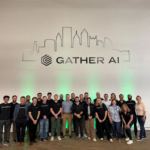
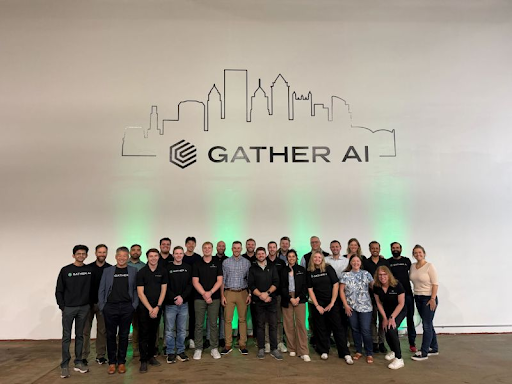
Gather AI is a Pittsburgh based startup building an AI platform that uses warehouse cameras and drones to monitor inventory and operations, and it is betting on a different kind of artificial intelligence than the large language models dominating today’s headlines. Founded by Carnegie Mellon University PhD students and led by co founder and CEO Sankalp Arora, the company has spent the past year expanding its customer base, growing to about 60 employees, and winning industry recognition for its vision technology. Now, Gather AI has raised a $40 million Series B funding round to scale further.
The round was led by Smith Point Capital, the venture firm founded by former Salesforce co CEO Keith Block. Gather first met Smith Point roughly a year ago at a logistics conference, and the connection clicked almost immediately. “It took Keith and his team five minutes to get what we’re doing,” Arora told TechCrunch.
What Gather AI is doing stands out in a crowded warehouse automation market. The three founders met while pursuing PhDs at Carnegie Mellon University, where they worked on autonomous flight systems and built one of the earliest autonomous helicopters. That technology was tested on the FBI training grounds in Quantico, giving the team deep experience in teaching machines how to navigate complex real world environments safely and independently. Block is also a trustee at Carnegie Mellon.
In 2017, the founders applied that research to warehouses, launching Gather AI with a focus on using off the shelf hardware rather than expensive custom robots. The company places cameras on moving equipment such as forklifts and deploys autonomous drones to fly through facilities. Those cameras continuously observe floor level operations and feed data directly into warehouse management systems.
The key difference, according to Arora, is that Gather’s AI is not randomly scanning everything it sees. Instead, it operates with what the team calls curiosity. The system actively decides what to inspect next based on what it has already learned, allowing it to focus on the most relevant information inside a facility.
“My PhD work focused on how to make flying robots curious,” Arora said. “Now they’re curious about boxes, bar codes, and workflows.”
Beyond barcodes, the system can read lot codes, text, expiration dates, case counts, and signs of damage or misplaced inventory. It also tracks space utilization and operational patterns, helping warehouses identify low inventory, incorrect placements, and workflows that could create safety risks.
Gather’s technology is also designed to operate in environments that are difficult or unsafe for people, including freezers and cold storage facilities. By automating routine checks in these spaces, companies can reduce manual labor while improving accuracy and frequency of inspections.
Despite being an AI company, Gather’s platform does not rely on large language models. The core system was built years before the recent LLM boom and uses a combination of classical Bayesian techniques and neural networks. These probability based vision systems allow the AI to reason about uncertainty and make decisions without the hallucination issues often associated with generative models.
Instead of generating text or images, Gather’s AI observes, learns, and decides where to look next in the physical world. This approach places the company at the forefront of what many researchers call embodied AI, systems that interact directly with real environments rather than through screens or chat interfaces.
That focus has started to earn industry recognition. In December, Gather AI won the 2025 Nebius Robotics Award for Vision AI and Streaming Video Analytics. The company’s customers already include major logistics and enterprise operators such as Kwik Trip, Axon, GEODIS, and NFI Industries.