
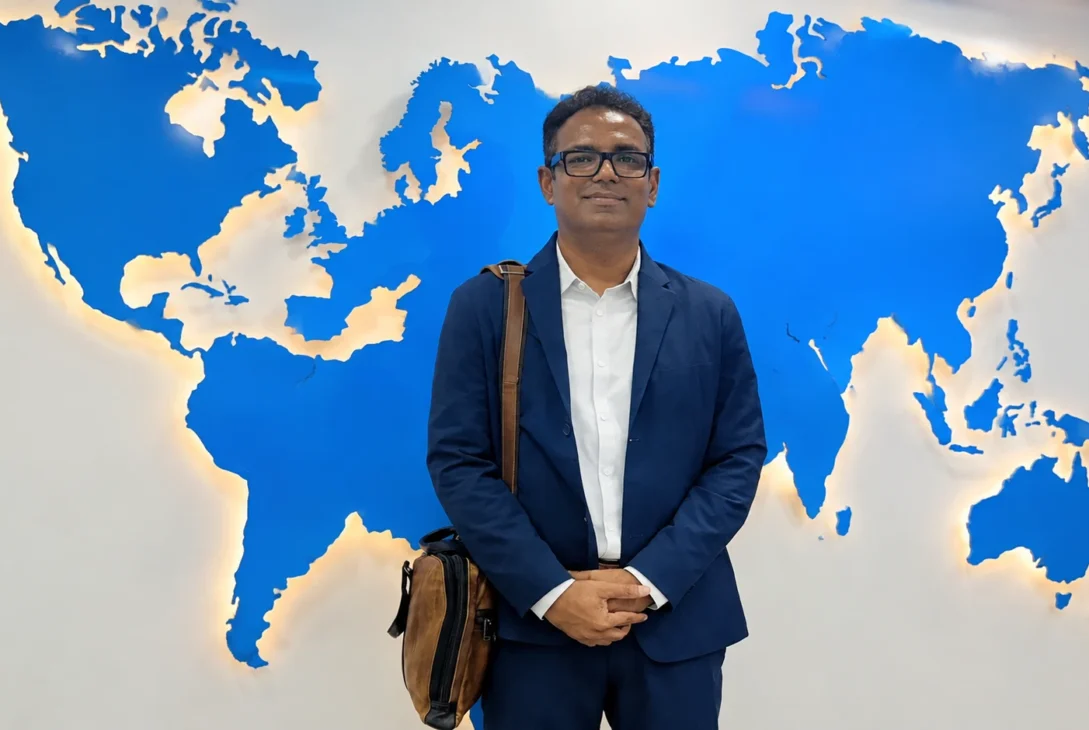
Prash Chopra spent years as an image-guided surgery engineer before deciding the surgical standard of care needed to be rebuilt from the ground up. In 2023, Chopra founded Petal Surgical alongside a notable team of clinical and technical co-founders: neurosurgeon Dr. Bowen Jiang, robotic spine surgery pioneer Dr. Nicholas Theodore, and Rony Abovitz, the founder of MAKO Surgical and Magic Leap. The company is developing a distinct form of histotripsy — a technique using focused ultrasound, robotics, and AI to destroy targeted tissue without cutting the skin — aimed at making surgery safer, more accessible, and less invasive.
Under Chopra’s leadership as Founder and CEO, Petal has built a board and advisory roster that includes Dr. Frederic Moll, a widely recognized pioneer of surgical robotics who helped found Intuitive Surgical. The company has raised $17.7 million to date, including a $10 million Series A round co-led by K50 Ventures and TSVC, with additional backing from ShangBay Capital, Tim Draper’s Draper Associates, and Moll himself. Investors have pointed to surgical-access gaps worldwide as the problem Petal is positioned to address, describing its approach as a way to make treatment more equitable for patients globally.
Chopra has articulated Petal’s ambitions in explicitly human terms, framing the company’s mission — “Making Healing Human” — around building an accessible, viable ecosystem of incisionless healthcare rather than simply another surgical device. He has said the company measures success not by innovation for its own sake, but by whether the technology can scale to serve billions of people, starting with a first community. Chopra has spoken publicly about the traits he looks for in early hires: integrity, alignment between words and actions, and a willingness to demand greatness rather than settle for perfection.
With Petal advancing toward its first-in-human study and Chopra continuing to represent the company at industry gatherings such as the LSI Med Tech Summit, his work reflects a broader push in medtech to combine robotics, AI, and clinical expertise into surgical care that is fundamentally less invasive than today’s standard.