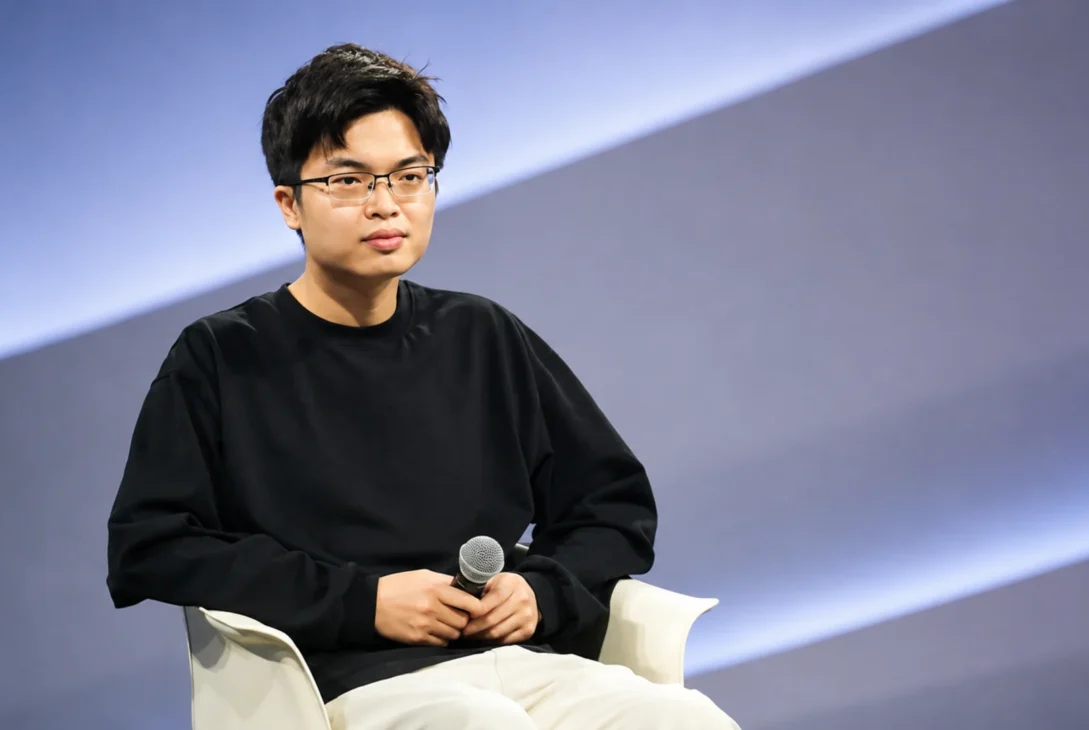
Zhilin Yang, Founder and CEO of Moonshot AI, has emerged as one of China’s most closely watched AI entrepreneurs, known for building the company behind the Kimi family of AI assistants. Born in 1992 in Shantou, Guangdong province, Yang studied computer science at Tsinghua University before completing a PhD at Carnegie Mellon University in just four years, under the guidance of researchers Russ Salakhutdinov and William Cohen. During his doctoral studies, he interned at both Google Brain and Meta, contributing to influential research including Transformer-XL and XLNet — foundational work addressing how language models retain context over long sequences.
Yang co-founded Moonshot AI in early 2023, taking its name — meaning “dark side of the moon” — from his favorite Pink Floyd album, reflecting an ambition to accomplish something as difficult and valuable as landing on the moon. The company gained national attention in China after releasing its first Kimi model later that year, quickly raising nearly $300 million across its first two funding rounds.
Moonshot’s breakthrough came in July 2025 with the release of Kimi K2, China’s first open-source trillion-parameter model, which became particularly known for its ability to process long documents through an unusually large context window. Within 48 hours of release, traffic to Kimi’s website surged by billions of visits, and downloads on Hugging Face exceeded 100,000. The company has since expanded into AI coding, research tools, and autonomous agents, securing backing from major investors including Alibaba and Tencent, reportedly raising $2 billion at a valuation exceeding $20 billion. Yang’s more recent release, Kimi K3, drew praise from figures across the AI industry, including his former PhD advisor Russ Salakhutdinov, and has been described by analysts as demonstrating that large-scale pretraining combined with architectural innovation can produce major capability gains even under hardware constraints. Yang has been named among a small group of contenders informally referred to as candidates for “China’s OpenAI,” and his decision to return to China to build Moonshot — rather than stay in the U.S. after his PhD — has itself become a point of broader industry discussion.